Captain Black Beaver
by Kerry Holton
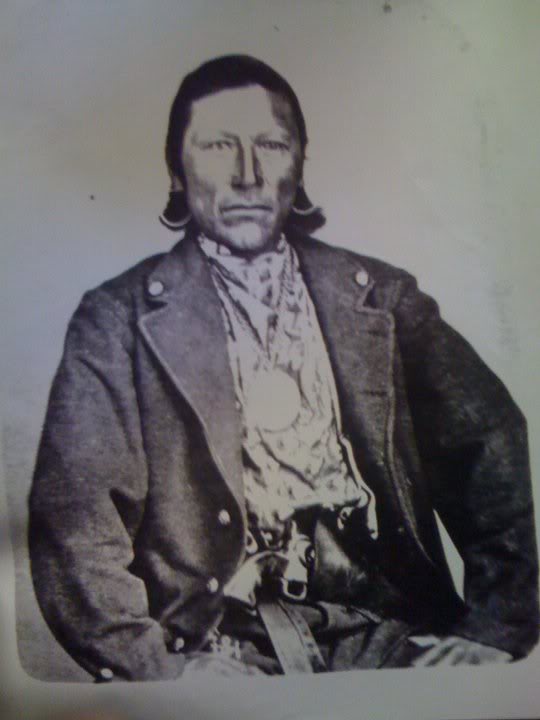
Captain Black Beaver with the Lincoln Peace medal.
Captain Black Beaver (Delaware Indian name: Se-ket-Tu-Ma-Quah), is amongst the famous Indians of America’s long and storied frontier history. An illustrious man, he applied himself to a plethora of varied crafts during his lifetime; a reconnoiter, interpreter, trapper, and leader, his birth is generally thought to have occurred sometime during the year of 1806 at an Indian village that is now the present-day city of Belleville, Illinois just outside of St. Louis. He was the son of Chief William Patterson and the Delaware’s were located in two locations at the time, with a majority in Indiana and the rest in Cape Girardeau Missouri. Very little is known about his youth, though he was a seemingly rambunctious child. Throughout his adolescence he spent his time hunting, trapping, and otherwise honing his skills in travel & survival. The first substantiated location of a young Black Beaver is in the mid 1820’s at the Wolf House on the White River in Norfork, MO. This is where the Delaware Nation had settled for a period and where many other tribes, trappers and westward travelers migrated through this location. Noteworthy people who lived here or passed through include Davey Crockett, Sam Houston and his brother John.
Black Beaver eventually gained employment with the American Fur Company, putting the skills he’d accrued during his early years to work as an exploration leader and fur trapper. He reportedly reached the Pacific Ocean on several occasions a rare feat at the time. Due to his fluency in English, French, Spanish, and multiple Indian languages, he was chosen to accompany the Dodge-Leavenworth Expedition of 1834 (an army expedition sent by the U.S government to placate and negotiate with southern Plains Indians who were starting to behave aggressively, and were also launching more and more attacks on traders traveling the Santa Fe trail).
The gold rush years of the mid-19th century provided ever more opportunity for Captain Black Beaver. In 1849 he led Captain Randolph B. Marcy and a very large group of foreigners (who were looking to partake in the supposed riches being unearthed in California) westward via the California trail, starting near Fort Smith, Arkansas and ending at the village of Santa Fe. For a year or two afterwards Black Beaver explored the southwest of what is now the United States of America, meeting the Plain Indian tribes and living off nature. Subsequently Captain Black Beaver settled down and spent some time in a small fort called Arbuckle, where he would spend a great deal of time. During his stay at Fort Arbuckle, Black Beaver was often times solicited for his scouting skills, for example by the Lieutenant Amiel Weeks Whipple of the U.S government; Black Beaver steadfastly refused all such offers, because he was to now to old and sickly to undertake such endeavors.
He would also later serve as a captain of an Indian unit in the U.S army during the Mexican-American war. It was during the Mexican-American war that Se-ket-Tu-Ma-Quah acquired the moniker Captain Black Beaver not by army title but bestowed by his tribe as a war leader. Black Beaver serving with Sam Houston formed and lead the Black Beaver Spy Company as an intelligence unit that dangerously crossed enemy lines and was very successful.
Sometime prior to the Civil War, Captain Black Beaver had left Fort Arbuckle and started farming in present day Caddo County along with other Indians who were taking advantage of land being offered by the U.S government. With the outbreak of the American Civil War, Black Beaver once more resumed his old role of scout, escorting Colonel William H. Emory’s Union troops from Fort Cobb to the southern portion of Kansas in April of 1861. Not only did he save Emory’s Union troops from demise at the hands of the Confederate army, he also forged the Chisolm trail in the process. This led to reprisal by the Confederate troops, in the form of the destruction of Black Beaver’s farming territory. This was just a small part of the full extent of Black Beaver’s known direct participation in the Civil war. Lieutenant Averell left Washington DC on April 17, 1861 to hand deliver the order of evacuation from Abraham Lincoln should Arkansas secede from the Union to find that Black Beaver had already removed the troops from Ft. Smith. After the war he became one of the main representatives for the Delaware Indians in negotiations with the U.S government. Black Beaver had garnered a great deal of respect from Washington authorities throughout his life, and was also highly respected by many different Indian tribes, including the Comanche and the Kiowa, so he was very well suited to the role of mediator.
Black Beaver participated in the Medicine Lodge treaty negotiations of 1867 and acted as a moderator in inter-tribal councils throughout the 1870’s. Three years prior to his death he became a Baptist minister, after having converted to Christianity in 1876. He had accumulated four wives and had an impressive progeny by the time of his death on May 8th, 1880 at the age of 74, at his daughter’s ranch west of Anadarko in what is presently Caddo County, Oklahoma. Captain Black Beaver was a mythic figure even during his own lifetime, mostly because of the massive amounts of territory he explored, his thorough experiences with both Whites and Indians, his skills as a scout, his well-liked personality, his expertise in interpretation, and his talents as a negotiator. He was a brave and proud man whose endurance was legendary. He was originally buried in Anadarko, Caddo County, Oklahoma, next to his great-grandfather, Elihu Burgin Osburn. He was later moved toFort Sill Post Cemeteryin Lawton, Oklahoma. Black Beaver’s original grave site is listed in the National Register of Historic Places.
This site is dedicated to the memory of Black Beaver that will grow and showcase in detail these and many more stories of adventure, diplomacy and leadership that a great man left for us to carry forward.


 Black Beaver
Was a bronze ever done of black beaver
LikeLike
To my knowledge a bronze was not made. However a carving was done of his face in exacting detail, as if cast from his actual face. So detailed that when I first saw it I thought it was a death mask. This carving is in inventory at the US Museum of Natural History where it was commissioned. I do not think the carving has ever saw the light of day. I’ve wondered if that carving was not done to eventually cast a bronze.
LikeLike